
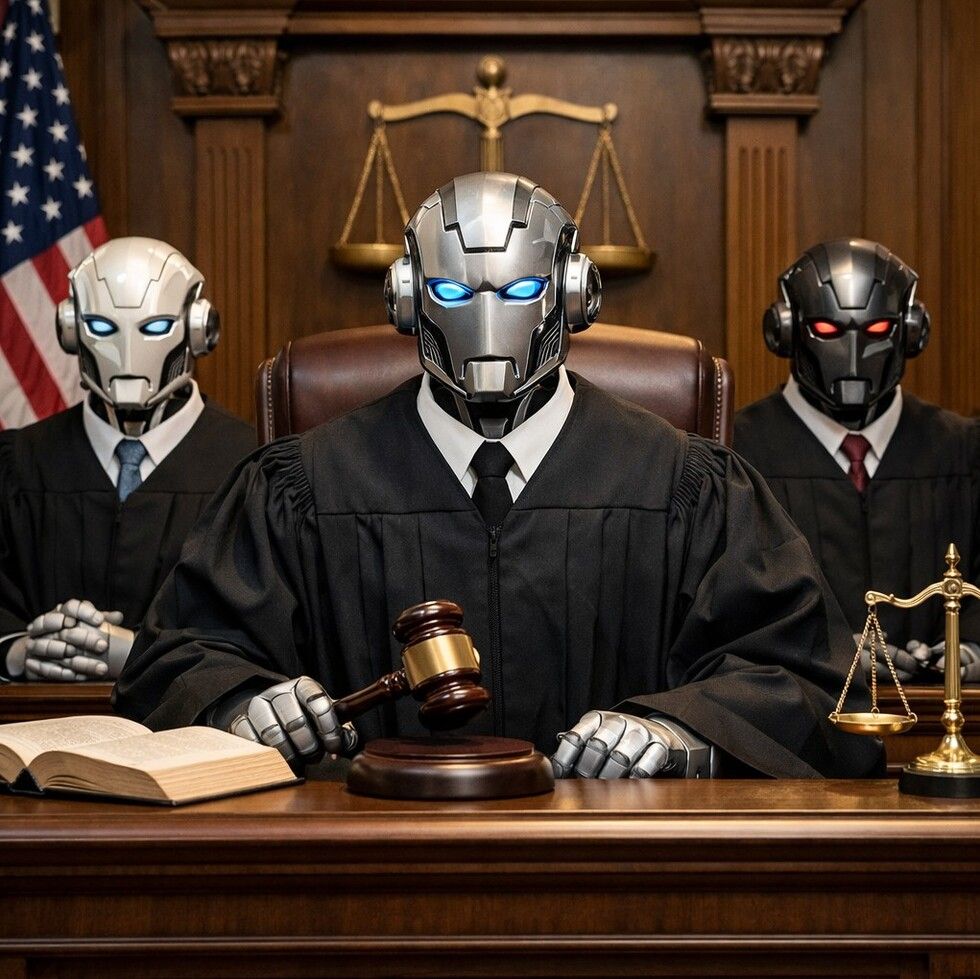
Robots in Robes? Introducing the AAA's "AI Arbitrator"

Introduction
There's talk of AI replacing everyone. Might it next be coming for our arbitrators and judges?
It's too early to say. But two things are certain. First, the purveyors of AI technology are trying to solve every conceivable problem with their latest and greatest AI large language models. Second, our legal system has long been plagued by certain problems, namely, slow-moving dockets, overwhelmed judges, and high costs.
Enter the American Arbitration Association's “AI Arbitrator."
In September 2025, the American Arbitration Association announced the development of an artificial intelligence system capable of analyzing disputes and drafting arbitration awards.[1] The “AI-led arbitration system” rolled out in late 2025 initially handling documents-only construction cases.[2] The system offers a significant departure from traditional adjudication, combining AI analysis with mandatory human arbitrator review, operating at a fixed cost of $2,500 for claimants (with respondents paying the same fee for a counterclaim),[3] and following compressed timelines without traditional discovery or motion practice. The process is cheap, ruthlessly efficient, and speedy: parties submit all evidence and arguments on 10-business-day deadlines before the AI Arbitrator goes to work.[4]
This article overviews the AAA's AI arbitration system, evaluates considerations for practitioners, and explores whether similar approaches could be implemented outside the AAA structure.
The AAA's AI Arbitration System
The AAA developed its proprietary “AI Arbitrator” in collaboration with QuantumBlack, AI by McKinsey, training the system on over 1,500 construction arbitration awards and refining it with expert-labeled examples from construction attorneys and trained arbitrators.[5] The system uses what the AAA describes as "legal reasoning as the foundation for its decision-making," employing structured legal prompt libraries and conversational AI to generate draft awards.[6]
The critical safeguard—and the feature the AAA emphasizes most heavily—is the "human-in-the-loop framework." The AI Arbitrator drafts the award, but the Human Arbitrator from the AAA's roster reviews, validates, and has authority to edit or completely rewrite any portion before finalizing the decision.[7] This human oversight arguably renders the "AI Arbitrator" more of a sophisticated drafting tool than an actual arbitrator in the traditional sense. On the other hand, the rules explicitly refer to their trained model as the “AI Arbitrator” that "leads" the process. This, combined with the minimal fixed cost of this process, suggests the organization's intention is for AI to handle as much of the adjudication as possible with human arbitrators acting primarily as a safeguard rather than as the primary decision-maker.
The system launched at first for construction disputes, which the AAA selected because it says they represent a "high-volume area where efficiency and speed are essential."[8] The AAA plans to expand to additional industries, dispute types, and higher-value claims in 2026.[9] The current arbitration cost is $2,500 per party for filing claims or counterclaims—a fraction of traditional arbitration fees.[10]
How AI Arbitration Rules Actually Work
The AI Led Arbitration Rules, effective November 20, 2025, establish a streamlined process.[11]
Discovery and Motion Practice: The AI Led Arbitration Rules do not address discovery or motion practice. There is no discovery phase described in the rules. There is no mechanism provided for dispositive motions, discovery motions, or disputes about discovery. Parties submit their evidence with their briefs during designated submission windows, and that is what the arbitrators—both AI and human—will consider.
The AAA's rules do provide a catch-all provision stating that "[i]f a situation arises that the Rules do not specifically address, the AAA or the human Arbitrator will determine the appropriate course of action."[12] This language could arguably permit the Human Arbitrator to authorize limited discovery or rule on motions if unusual circumstances warrant departure from the standard documents-only process. How often this discretion would be exercised is uncertain.
Submission Schedule: Once a respondent files a brief response (or the response deadline passes), the system creates an automatic schedule.[13] The claimant gets 10 business days to submit proof supporting the claim, including written statements, evidence, exhibits, and legal authority.[14] The respondent then has 10 business days to respond and may file a counterclaim during this period.[15] The claimant gets a final 10-day reply period.[16] Each party may request one five-business-day extension per submission period.[17] The AAA may grant further extensions only in "unusual and exceptional circumstances."[18]
The AI arbitrator confirms each submission and generates summaries of the parties' claims, evidence, and legal arguments.[19] During a "Parties' Feedback" stage, parties can review and comment on these AI-generated summaries—a transparency feature designed to catch misunderstandings before the award is drafted.[20]
The "Trial": There is no trial in the traditional sense. There are no oral arguments, no witness testimony, no cross-examination, and no evidentiary hearings. The process is entirely documents-only. After the submission stages and feedback period conclude, the AI Arbitrator generates a draft award with brief reasoning, potentially including damages, attorney's fees, and cost allocation.[21] The Human Arbitrator then reviews this draft and can approve, edit, or completely rewrite it.[22] The Human Arbitrator must render the final award within five business days after the feedback stage deadline.[23]
Disputes and Extensions: The rules provide minimal mechanisms for resolving disputes. The AAA—not the arbitrator—has exclusive authority to interpret and apply the rules, make decisions about procedures and rule non-compliance.[24] If situations arise that the rules don't address, the AAA or Human Arbitrator determines the appropriate course of action.[25] For extension requests beyond the single automatic five-day extension each party receives, the AAA decides whether "unusual and exceptional circumstances" warrant additional time.[26] The rules provide no specific process for adjudicating these determinations.
Confidentiality and Transparency: All case materials and submissions are kept confidential, with the AAA emphasizing that "AI access to data is limited and secure."[27] The AAA states its rules follow the AAA's commitment to "responsible AI use" with principles of "fairness, transparency, and keeping people at the center of decisions."[28]
Evaluating AI Arbitration for Client Disputes
The question of whether to utilize AI arbitration involves weighing several competing considerations. The technology is novel and its track record limited. AI systems are not infallible and can produce errors, including "hallucinations"—confidently stated falsehoods that appear plausible. There are documented techniques for manipulating AI outcomes through clever prompting. These risks are real and counsel caution, particularly for high-stakes disputes or those involving complex legal questions.
At the same time, the relevant comparison may not be between AI arbitration and perfect justice, but between AI arbitration and the alternatives actually available to clients. For many disputes, those alternatives are: (a) human arbitrators who charge significantly more; (b) court litigation that may be economically impractical; or (c) no formal dispute resolution at all.
The economic threshold problem is particularly acute. For disputes under approximately $20,000—and arguably higher—traditional litigation often makes little economic sense. When attorney fees could equal or exceed the amount in controversy, and when litigation outcomes are inherently uncertain, pursuing even meritorious claims becomes economically irrational. This reality effectively places certain categories of legal disputes beyond the reach of the justice system for parties unable to absorb litigation costs as overhead.
AI arbitration offers resolution at a fixed, predictable cost. For $2,500 for the claimant (plus the same amount for the respondent only if a counterclaim is filed), plus the cost of brief preparation, disputes can be adjudicated rather than abandoned.[29] If the alternative for a particular dispute is no resolution mechanism at all, AI arbitration provides value even if imperfect.
The AAA's human-review requirement provides quality control that may be meaningful to some participants. A trained human arbitrator reviews every AI-generated award and has authority to edit or completely rewrite it before finalization.[30] This hybrid approach attempts to capture efficiency gains from AI processing while maintaining human judgment as a safeguard against computer errors.
The system also includes a non-binding arbitration option under Rule R-13. Parties can agree at the outset that the award will be advisory only, using AI arbitration as a case evaluation tool while maintaining ultimate control over whether to accept the outcome.[31] This flexibility allows parties to experiment with the technology without fully committing to AI-generated results.
Whether AI arbitration is appropriate for a particular dispute depends on multiple factors: the dollar amount at stake, the complexity of the legal and factual issues, the parties' comfort with technology, the availability and cost of alternatives, and the consequences of potential errors. For straightforward disputes with modest dollar values where traditional arbitration or litigation is economically prohibitive, AI arbitration may provide access where none previously existed. For complex, high-stakes matters between parties of means, traditional processes likely remain preferable despite higher costs.
AI Arbitration Without the AAA
The AAA emphasizes that it developed AI arbitration for construction litigation because in that context "efficiency and speed are essential."[32] But efficiency and speed are essential in many other areas of law. Indeed, our system is inherently slow and inefficient, and this has created a great many problems. Among other things, those unable to afford attorneys to deal with inefficient procedures—and pay those attorneys to do so over extended periods—are systematically excluded from our system. AI arbitration may solve these problems regardless of whether disputes fit the AAA's initial target market.
Given the current accessibility of cutting-edge "frontier models"—which can be accessed for nominal monthly fees—some might question whether paying the AAA's $2,500 fee is even necessary. Nothing stops parties from simply agreeing to AI arbitration in accordance with rules they create themselves, using commercially available AI systems. Claude, ChatGPT, and other large language models are capable of ingesting legal arguments, evidence, and drafting decisions.
Due process has always required a neutral decisionmaker. Can AI understand a dispute or reason to a decision the same way a human can? Whether and how an AI large language model (LLM) “reasons” is a matter of legitimate, cross-disciplinary debate beyond the scope of this article.[33] The AAA is betting that at least some litigants will look past this debate. If the parties agree to the AAA's process, the adjudication will proceed as if the AI is fully capable of “leading” an arbitration and acting as an “AI Arbitrator.”
Once one accepts the premise that an AI can lead and adjudicate their case (or at least agrees to act as if it has that capability), the question is merely whether AAA's specially trained model offers a benefit worth the AAA's cost. Whether specially trained models like the AAA's offer significant benefits over general-purpose frontier models with proper prompting remains an open question.[34] The latest frontier models offered by the likes of OpenAI (ChatGPT) and Anthropic (Claude), with proper prompting and context provided by the user, have shown mixed results compared to fine-tuned models in at least some domains. Id.
For practitioners considering implementing this approach, several practical considerations merit attention:
Mutual Agreement is Essential: Both parties must be comfortable with and explicitly agree to AI arbitration. This is not a process to spring on an opposing party or include in boilerplate arbitration clauses without discussion. The novelty of the approach and legitimate concerns about the technology require informed consent from all participants.
Define the Binding Effect: Rather than treating arbitration as binary—fully binding or non-binding—consider intermediate approaches that provide flexibility while maintaining incentives for compliance:
· Purely Advisory (Case Evaluation): The AI award serves as a non-binding "mock verdict." This is ideal for parties seeking a neutral "reality check" to facilitate settlement negotiations without surrendering their right to a day in court.
· Presumptively Binding with "Fee-Shifting" Triggers: The award becomes final unless a party formally rejects it within a set period (e.g., 14 days) to pursue traditional litigation. To discourage strategic or bad-faith rejections, the rules can stipulate that if the rejecting party fails to improve their outcome by a specific margin (e.g., 10-20%) in court, they must indemnify the opposing party for reasonable legal fees and costs incurred during the litigation.
· High-Low Arbitration: The parties agree in advance to a "floor" and a "ceiling." Regardless of the AI's specific award, the final payout cannot drop below or exceed these pre-set amounts. This caps the "hallucination risk" while still providing a definitive resolution.
· Fully Binding (The "Efficiency-First" Model): The award is final and subject only to the narrowest grounds for vacatur under the Federal Arbitration Act. This is the "live on the edge" approach, best suited for high-volume, low-dollar claims where the cost of a "correct" human decision exceeds the amount in controversy.
Establish Clear Procedural Rules: The AAA's rules provide a useful template, but parties can customize based on their specific needs. Key elements to address include submission deadlines, page limits, whether to allow limited discovery, how to handle document authentication, and the scope of relief available.
Select the AI System and Prompting Framework in Advance: Different AI systems have different strengths. Some handle complex multi-factor analysis better, others excel at following rigid procedural frameworks. The prompt engineering—how you instruct the AI about its role, the applicable law, and the decision framework—significantly impacts outcomes. Consider having a neutral third party (perhaps an attorney trusted by both sides) design the prompts and manage the AI interaction to prevent gaming.
Build in Human Review: Even for private AI arbitration, consider requiring review by a neutral attorney before awards become final. This need not involve the expense of a formal arbitrator. A competent attorney reviewing the AI's work for obvious errors, legal mistakes, or reasoning failures could provide meaningful quality control at modest cost. Think about how much authority the human should have to change the award, up to and including total authority to ignore the AI output and substitute their own judgment.
Document Everything: Maintain clear records of the agreement to arbitrate, the procedural rules, all submissions, the AI system used (including version information), the prompts employed, and the complete output. This documentation protects against challenges to the process and provides court review materials if needed.
Conclusion
The idea of AI-led adjudication seems strange and perhaps scary at first. The notion of entrusting legal disputes to algorithms challenges traditional assumptions about how justice should be administered. But the concept should not be dismissed out of hand. The current inaccessibility of our legal system to those of modest means, or even those who simply happen to have small claims, will make this type of AI adjudication very attractive. Thus, it would not be surprising to see this idea expanded.
The AAA's AI Arbitrator represents a significant development in dispute resolution technology. Any attempt to have computers replace human decisionmaking will be controversial. The AAA's step represents a serious effort by a well-respected organization to make this idea a reality.
As AI capabilities continue developing and as practical experience accumulates, understanding of appropriate use cases will improve. Practitioners evaluating AI arbitration should assess the specific characteristics of each dispute—dollar amount, factual complexity, legal novelty, and availability of alternatives—rather than adopting categorical positions for or against the technology. Our legal system faces substantial and seemingly intractable access-to-justice challenges. AI arbitration just may address some of these challenges for certain categories of disputes, even if significant questions about the approach remain unresolved.
About the Author
William (Bill) Tasch is Managing Partner of CTM Legal Group, a Chicago law firm focusing on accessible and cost-effective legal solutions. His practice centers on litigation in state and federal courts. Mr. Tasch serves on the Illinois State Bar Association's Law Office Management and Economics Committee as well as the Delivery of Legal Services Committee and its AI Subcommittee.
Endnotes
- AAA Press Release, "AAA-ICDR® to Launch AI-Native Arbitrator, Transforming Dispute Resolution" (Sept. 17, 2025) available at https://www.adr.org/press-releases/aaa-icdr-to-launch-ai-native-arbitrator-transforming-dispute-resolution/.
- Id.
- AAA, AI Led Arbitration Rules, Arbitration Cost; Refund Schedule (eff. Nov. 20, 2025).
- Id. at R-4, R-6, R-8.
- AAA Press Release, supra note 1.
- Id.
- AAA, AI Led Arbitration Rules, R-8(a)(ii) (eff. Nov. 20, 2025).
- AAA Press Release, supra note 1.
- Id.
- AAA, AI Led Arbitration Rules, Arbitration Cost; Refund Schedule (eff. Nov. 20, 2025).
- AAA, AI Led Arbitration Rules (eff. Nov. 20, 2025).
- Id. at R-1(b).
- Id. at R-6(a).
- Id. at R-6(a)(i).
- Id. at R-6(a)(ii).
- Id. at R-6(a)(iii).
- Id. at R-6(d).
- Id.
- Id. at R-6(e).
- Id.
- Id. at R-8(a)(i).
- AAA, AI Led Arbitration Rules, R-8(a)(ii) (eff. Nov. 20, 2025).
- Id. at R-8(b).
- Id. at R-1(a).
- Id. at R-1(b).
- Id. at R-6(d).
- Id. at R-9.
- Id. at Introduction.
- Id. at Arbitration Cost; Refund Schedule.
- AAA, AI Led Arbitration Rules, R-8(a)(ii) (eff. Nov. 20, 2025).
- Id. at R-13(a).
- AAA Press Release, supra note 1.
- Mitchell, M., & Krakauer, D., "The Debate Over Understanding in AI's Large Language Models," Proceedings of the National Academy of Sciences (PNAS) (2023). This research highlights the lack of consensus among computer scientists, cognitive scientists, and philosophers regarding whether LLMs possess genuine conceptual mastery or are merely executing sophisticated pattern matching. Fascinating literature on the subject abounds. Among them, a new study suggests LLMs solve problems using significantly more “surface-level ‘shortcuts'” than humans. Beger, C. et. al. “Do AI Models Perform Human-like Abstract Reasoning Across Modalities?” arXiv:2510.02125v4 [cs.AI] 2 Feb 2026 Preprint, accessed 4 Feb 2026.
- The jury is out on whether and to what extent specialized fine-tuning of models beats good prompting on the latest and greatest LLMs. Indeed, the answer may be changing by the month. See Shin, J., et al., "Prompt Engineering or Fine-Tuning: An Empirical Assessment of LLMs for Code," arXiv preprint arXiv:2310.10508v2 (2025). The study found that GPT-4 with prompting strategies outperformed fine-tuned models in some circumstances, but not consistently. Conversational prompting of general models with human feedback showed significant improvements. One AI development team observed "there is an observable trend of diminishing returns from fine-tuning. While fine-tuned Davinci showed marked improvement over its base model, fine-tuned GPT-3.5 offered lesser gains, and the progress achieved by fine-tuning GPT-4 was even smaller." Supersimple, "First Impressions of Early-Access GPT-4 Fine-Tuning" (2024), available at https://www.supersimple.io/blog/gpt-4-fine-tuning-early-access. See also Branzan, C., "The Fine-Tuning Renaissance: Why LLM Customization Is Surging Again," Medium (Oct. 20, 2025), available at https://medium.com/@claudiubranzan/the-fine-tuning-renaissance-3428c5f8221a (explaining that specialized fine-tuned models fell out of favor in 2025, but arguing that fine-tuning was making a comeback as of October 2025).